Pages

Wednesday, June 19, 2013

The Farmer: Honorable, Noble and Partner with God

http://www.colourbox.com/preview/4434418-983541-blueberries-raspberries.jpg 
Recently, I ran across a very old 12th century liturgy referencing a Spanish farmer and his wife - St. Isidore and S. Maria de la Cabeza.

Below is a portion, a Reflection, on the person and calling of a farmer.  It is wonderful in its scope, depth and beauty.  I immediately thought of my many neighbors in Whatcom County who are farmers.  I specially thought of my Punjabi friends and neighbors who are farmers who are berry growers.  

I pray that this year is good to all these honorable farmers - whatever culture they come from.  I pray the harvest be bountiful.  May all the risks and labors of our farmer community be worth the joy they will receive at summer's end!
 -------------------
The farmer's is a sacred calling because he is a collaborator with God in the work of His creation. In partnership with God he becomes to men a provider of the food, fiber, and shelter they need. Let the farmer, then, no longer belittle himself in his own eyes. The farmer's calling is among the noblest in all the world. The Lord considered it so, and the farmer must think of it in the same terms. With God he lives and works in the vast realms of His bountiful and beautiful nature. He is not one of the millions who in thick formations swarm through factory gates. He is a free man as he strides through his fields guiding a plow, sowing the seed, or harvesting the crop. The farmer's calling is one that must command great respect. Much knowledge and skill are required to manage well the farmstead with its land and fences, barns and granaries, tools, and machinery. Farming is among the greatest of human arts. The farmer must be an artisan and a craftsman, a capitalist, financier, manager, worker; a producer and a seller. He must know soil and seed, poultry and cattle; he must know when to till the soil, cultivate his fields, and harvest his crops. In the presence of his Lord the farmer should recall all this, not in a spirit of vainglory or pride, but in grateful appreciation of the calling that God gave him as a tiller of the soil. Praise and thanksgiving should rise in his heart as he reflects on the high regard the Lord has showered upon him and his work.
-------------------
I say: AMEN to that! 
Tuesday, April 16, 2013

Viasakhi Celebration Lynden April 29, 2012


A number of us attended last spring's Viasakhi Celebration at the Gurdwara just south of Lynden.  A special time to met wonderful Punjabi folk, eat their great vegetarian dishes, and take in the background and meaning of this day.  Sorry the video quality is not the best.  We are very much looking forward to this April's Viashakhi Day!

Friday, February 22, 2013

Cameron feels ashamed for Jallianwala Bagh massacre but doesn’t say sorry

[Reposted from the Punjab Star News] 
February 22, 2013

Amritsar: Nearly 94 years after over 1,000 Indian protesters were killed in Jallianwala Bagh during the British Raj; Prime Minister David Cameron on Wednesday described the incident as "deeply shameful" but stopped short of a public apology. 46-year-old Cameron, who is the first democratically elected British Prime Minister to visit the 1919 Jallianwala Bagh massacre site, kneeled down while paying tribute to martyrs and observed one-minute silence with folded hands as a mark of respect. Writing in the visitor's book of Jallianwala Bagh, Cameron said, "This was a deeply shameful act in British history, one that Winston Churchill rightly described at that time as monstrous.

We must never forget what happened here and we must ensure that the UK stands up for the right of peaceful protests around the world". Some organizations had pressed for an apology from the British Premier during his visit to the site. Cameron's trip comes 16 years after Queen Elizabeth II and her husband Prince Philip visited Amritsar in 1997. He paid floral tributes to the martyrs of Jallianwala Bagh. He also stood for a few seconds before the Amar Joyti (burning flame) at Jallianwala Bagh where he bowed his head to show respect to the martyrs.  

He spent nearly 25 minutes in the park. Indian media was kept at a distance during the visit of Cameron. Only photojournalists were allowed to click from a distance. The Jallianwala Bagh massacre had taken place in Amritsar on 13 April, 1919. On hearing that a meeting of 15,000 to 20,000 people was taking place at Jallianwala Bagh, Brigadier General Reginald E H Dyer had ordered 50 riflemen to shoot at the crowd. Dyer kept the firing for about ten minutes, till the ammunition supply was almost exhausted with approximately 1,650 rounds fired that resulted in the killing of more than 1000 innocent Indians besides leaving more than 1100 injured. Earlier,Cameron paid obeisance at the Golden Temple where he was presented a robe of honour. Clad in a dark suit and a tie with head covered with a blue-colored cloth, Cameron was presented a robe of honour inside the sanctum sanctorum of Harmandir Sahib. The British Prime Minister also mingled with a couple of devotees and chatted with them for a brief period as Gurbani played in the backdrop. Inside the Temple, he was accompanied by Punjab Chief Minister Parkash Singh Badal, who earlier received the British dignitary at the Sri Guru Ram Dasji International Airport, Shiromani Guruduwaras Prabandhak Committee (SGPC) President Avtar Singh Makkar, among others.

The British Prime Minister reached the Golden Temple at about 9:50 am and spent nearly an hour inside. Cameron had his hands folded for a brief period as he paid obeisance inside the sanctum sanctorum of the Golden Temple, which attracts a large number of devotees cutting across faiths from different parts of the world. Before paying obeisance, he was taken around the Temple by officials of the SGPC, apex religious body of the Sikhs, and was also shown Shri Guru Ram Dass Langar Hall. Around 3,000 police personnel from six districts were deployed along with other forces, as part of the tight security arrangements for his visit. PTI

Wednesday, February 20, 2013

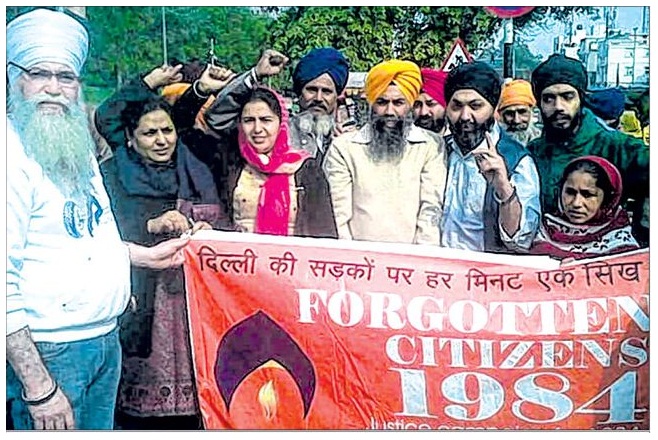
Sikh Genocide 1984 survivors staged protest

[Repost from Sikh Siyasat.net]
New Delhi, India (February 20, 2013): On February 19, 2013 a Delhi court reportedly took strong exception to the CBI’s failure to advance final arguments in a November 1984 Sikh massacre related case against Congress leader Jagdish Tytler as the victims staged a protest outside against the alleged delay in handing out justice.
Sikh protesters outside a Delhi Court on February 19, 2013
The victims of the genocidal violence reportedly gathered outside the Karkardooma Court complex here and shouted slogans demanding justice for them and their family members killed during the November 1984 massacres.
As per reports the protesters were raising slogans seeking strict punishment for Tytler and Congress leader Sajjan Kumar, who is facing trial for his alleged role in instigating the mob to kill Sikhs after the assassination of then prime minister Indira Gandhi on October 31, 1984.
The court directed the CBI prosecutor, who sought more time for advancing his arguments, to begin his arguments on the next date of hearing on March 20, 2013 failing which the judge would pass the order on the basis of available evidence.
The court was hearing final arguments on the protest petition filed by Lakhwinder Kaur, whose husband Badal Singh was killed during Sikh genocide 1984 in Delhi.
Jagdish Tytler
Jagdish Tytler, one of the former Indian ministers who are accused for their involvement in Sikh Genocide 1984
It is notable that after the assassination of Indira Gandhi on October 21, 1984 thousands of Sikhs were killed in a series of organized massacres throughout India in the first week of November 1984. The genocidal violence against the Sikhs was perpetuated by political leadership using state infrastructure.
Perpetuators of this crime were harbored by the Indian state. Many of them were rewarded with political and governmental positions of power for last 28 years. It is further notable that Indian judiciary has also drastically failed to bring culprits of the book and impart justice to the victims and survivors of the genocide. Jagdish Tytler is one such accused who did not face trial for his involvement in the November 1984 genocidal violence against  the Sikhs.

Tuesday, February 19, 2013

Visit to the Langar Hall - True Joy

Today, three of us visited the Langar Hall of the Guru Nanak Gursikh Gurudwara, Lynden, Washington.  What simple, sweet joy!  

Here it is, we outsiders were sitting alongside stranger-friends from among the Punjabi Sikh community, being served and eating their great food.  The conversation was wonderful...enlightening.  Very comfortable and in dialogue.  The east Indian tea marvelous.  Hospitality overflowed. 

Loved seeing again the 2-day old pictures of a 21-day old new born daughter of one of the Gurdwara's attendants.  Can you imagine the joy in his, the father's face?  Can you?

Wish I had taken pictures of the simplicity of this event.  But I forgot.

Here we sat, being served and attended to with great honor and care.  Something started right from the get-go with Sri Guru Nanak Ji many centuries ago.  All the people, all the Langar meals, all the true hospitality...here we sat in the midst of such care.

I love these people.  How wonderful!

Sunday, February 17, 2013

Afghan’s only Sikh MP recounts her struggle


We pray Anarkali Kaur Honaryar is protected, empowered and successful in her most heroic work.  What determination and bravery!

A Contrarian View of Gandhi

"White House yanks petition to reassess Obama’s hero Gandhi" 

By Parmjit Singh 
February 15, 2013 
SikhSiyasat Network News

This is an eye opener for some of us here in North America.  

Just a week ago, I was visiting a local Gurdwara, and there on one of the Langar tables was a newspaper written in Punjabi.  I turned a few pages and found one with the picture of Gandhi.  I asked a nearby Sikh gentleman to tell me what the caption and article said about Gandhi.  It was not positive nor flattering. The reference to Gandhi's sexual exploits was described with serious distain.  

Now I read this article [entitled above] and am starting to learn, in my wealth of ignorance, the 1947 Partition and Gandhi's role to this very day is a matter of great angst within the greater Punjabi-Sikh community.

I need to learn more on this most important intersection of history.

Saturday, February 16, 2013

Sikh Environment Day


This year Sikhs worldwide will be celebrating the 3nd Annual worldwide Sikh Vatavaran Diwas (environment day) celebrations the week of March 14th, 2013. This day marks the New Year in the Sikh calendar and the Gurgaddi Diwas of Sri Guru Har Rai Ji, who is remembered in Sikh history for his deep sensitivity to nature and its preservation.

Last year, over 1000 Gurdwaras, schools, and organizations were involved in Sikh Environment Day, sharing what the gift of air, land, and water means to them!

This year we plan to reach a new target – 1500 Gurdwaras, schools, and organizations in Punjab and the Diaspora holding events celebrating the message of ‘Pavan Guru Pani Pita, Mata Dharat Mahat.’ From divaans to tree plantings, to installing solar panels to hosting workshops, from gardening to hearing stories from our elders, the day is a time for Sikhs to celebrate their connection with the environment.

Thursday, February 14, 2013

My Valentine ~ poem by Vaninder Kaur

 I thought this poem today would share in a meaningful way, the heart of Vaninder Kaur.


[Found at SikhNet.com]


Guidelines when visiting the Sikh Gurdwara


All visitors to a Sikh Gurdwara should be aware of the following guidelines when visiting. Any person of any caste, creed, race, color and sex can visit the Gurdwara.

      • Dressing - Please dress appropriately so that you can comfortably and with decency sit on the carpeted floor. It is recommended that all visitors to the Gurdwara wear loose fitting clothing which covers most of your legs. Low hanging or tight-fitting pants/trousers may not be suitable. Please try sitting on the carpeted floor at home for a short period to see if the clothing is suitable.

      • Shoes - All visitors entering the Main Prayer Hall, called the Darbar Sahib and the Dining (Langar) Hall will have to remove their shoes and place them in the shoe racks provided.

      • No Smoking - Strictly No Smoking is allowed in the vicinity of the Gurdwara premises. Visitors cannot enter the Gurdwara while under the influence of Alcohol or Drugs. You should not take cigarettes or tobacco with you into the premises or smoke while near the Gurdwara or soon before going into the Gurdwara.

      • Head - All visitors MUST cover their heads while in the main Gurdwara areas i.e., (Darbar Sahib and Langar Hall). Head covering for men/boys will normally be available in the Gurdwara but a large knotted handkerchief is acceptable. (The Gurdwara may provide handkerchief sized cloth to cover the head). Other hats and caps (i.e., baseball-style caps) may not be appropriate as they are considered disrespectful. Sikh men normally wear a Turban. Women/girls will need to wear a headscarf. The Gurdwara usually has a box of scarves, but you could bring your own headscarf for this purpose. Sikh ladies usually wear a "Chunni", which is normally a long, flowing semi-transparent plain cloth with a decorated, veiled edging.

      • Seating - Chairs are not provided in the Gurdwara and so, when sitting, this will be on the carpeted floor both in the Main Prayer Hall (Darbar Sahib) and in the Langar Hall. (A few chairs may be available in the Langar Hall for visitors who have difficulty sitting on the floor due to old age or other medical conditions).

      • Bowing to the Guru - On first entering the large prayer room (called the Darbar Sahib), a small bow to the Guru Granth Sahib (the holy book) shows respect to the host community. Backs should not be turned on the Guru Granth Sahib or the soles of the feet pointed towards the Sikh holy book when sitting on the carpet. It is normal to sit cross-legged yoga style. It may be a good idea to practice this at home if possible before your trip to the Gurdwara.

      • Kara Parshad - Visitors will usually be offered Kara Parshad (sweet flour and oil based food offered as a gift) in the worship hall, which is usually given in cupped hands and eaten with the right hand. If you are uncertain about your ability to eat a lot of this food – Say “very small portion” to the Sewadar (volunteer) serving the Kara Parshad. You should take a small plastic bag (or ask for one from the Sewadar (volunteer) serving the Kara Parshad) to save your Kara Parshad if it is not to your taste – Please do not refuse it or throw it away.

      • Langar - You may be offered Langar (vegetarian food from the communal kitchen). If not too certain about consuming this food you can ask to be excused although most people should take langar as it is regarded as a blessing by the Guru. When in the Langar Hall, it is better to ask for less rather than take too much and waste the food. Say “very little” to the Sewadar (volunteer) serving the Langar. If you require more later, just wait for the Sewadar to come around.

Wednesday, February 13, 2013

The Paradox of India’s Bread Basket: Farmer Suicides in Punjab

[Reposted from PRAXIS The Fletcher Journal of Human Security]

Mallika Kaur


The rising number of farmer suicides in the Punjab region of India exposes the problem of extreme rural insecurity, which contradicts the prevalent narrative of one of the fastest-growing national economies in the world. Traditionally agrarian, Punjab’s agricultural output was increased manifold when the Central Indian Government chose Punjab as the site for the “Green Revolution” in the 1960s. Three decades later, without any alternate source of employment, small and marginal farmers of Punjab continue to pursue the environmentally and economically unsustainable agrarian practices of the Green Revolution, while accumulating high agrarian debt. Though estimates vary, reports of a significant number of farmer suicides are emerging from the region known as India’s “bread basket.” The Central Indian Government’s lack of attention to the phenomenon is exacerbating social inequalities, structural marginalization, and agrarian anxiety. After exploring the roots and various dimensions of Punjab’s agrarian problem, including the effect of predominantly male suicides on women and children, this article suggests immediate policy interventions necessary on the part of the Central Government in order to create a rural human security that is equitable, inclusive, and lasting.
Read More....

In a news article in The Times of India, we read about how the Punjab government has responded in recent days, with financial support to grieving families.

And a study in 2010 also sheds light on this very sad and troubling situation among some of the farmers in Punjab.  Written by Dealluck Irengbam in the International Journal of Management & Business Studies, the author states:

Punjab is going to approach environmentalism ,labour diversification and economic growth moving forward. The agricultural system that had been introduced as part of a development, project has failed for especially the weaker parts of Indian society ie agricultural labourers, marginal and small farmers. It already boasts one of the highest unemployment rates, and despite its agricultural success, farmers livelihoods have been declining resulting in a record number of farmer suicides. The various reasons, for suicides
among Punjab farmers is perturbing enough to warrant a serious study. In the present case, suicide among Punjab farmers have by all means become a public issue as these are no longer confined to isolated cases.


Tuesday, February 12, 2013

Agricultural Marketing Service Accepting Nominations for National Processed Raspberry Council


USDA is seeking nominees for the National Processed Raspberry Council (Council).  The Council is composed of 13 members and their alternates.  Members of the Council meet periodically to set a budget, and develop and carry out generic promotion, research, and information activities relating to processed raspberries.  This is an industry funded program, and it supports the national marketing and promotion of processed raspberries.  USDA’s Agricultural Marketing Service oversees the Council activities to ensure fiscal responsibility, program efficiency and fair treatment of participating stakeholders. The Council members and alternates serve without compensation, but shall be reimbursed for reasonable travel expenses.

To be considered eligible, one must be a producer of raspberries for processing.  In addition, that producer must have produced at least 20,000 pounds of raspberries for processing in calendar year 2012.  The definition, “processed raspberries”, refers to raspberries which have been frozen, dried, pureed, made into juice, or delivered in any other form altered by mechanical processes (not fresh raspberries).

If you fit the eligibility requirements as a processed raspberry producer, you are encouraged to submit an application.  If you know of an eligible producer, please help us reach out to them to make them aware of this important opportunity.

Please remember applications for membership on the National Processed Raspberry Council are due no later than February 19, 2013. 

Nomination Form
Background Information Form 

For more information, call the USDA Agricultural Marketing Service’s Outreach Office at (202) 690-0487, or send an email to billy.cox@ams.usda.gov. 

J. Latrice Hill
(Acting) Outreach Director
USDA/FSA/DAFO
400 Independence Ave SW Stop 0539
Washington, DC  20250
Telephone:  202.690.1700
Email:  Latrice.hill@wdc.usda.gov
Web:  www.fsa.usda.gov 

A Guidebook We Plan to Use


We just received several copies of Sikhism - Simple Guides by Sewa Singh Kalsa.  
 
This book provides an excellent overview of the Sikh faith.  We are ordering more copies. 
 
Our FOPN group will be using this book as our guide to learni about the faith of our Punjabi neighbors.  We have found the more we understand the Sikh faith, even when we come from different world views, like Christianity, we have much in common…much to talk about…much to share.

Thursday, February 7, 2013

Sikh Immigration to the Pacific Coast

Here is a very nice Chronology of the Immigration of Sikhs to the west coast of North America going back to 1897. 

If anyone has additional similar like chronologies with more detail, please share in comments.

Thanks to the Sikh Pioneers web site! 


Wednesday, February 6, 2013

Farmers in the grip of one of the worst economic crisis in recent history: Badal


[From: Punjab News Express]
CHANDIGARH: The Punjab Chief Minister Mr. Parkash Singh Badal today sought Prime Minister Dr. Manmohan Singh's "urgent, immediate and effective intervention" for a central package of Rs. 2380 crore for the beleaguered Punjab farmers reeling under one of the worst Monsoon failures in recent history.

The Chief Minister’s impassioned plea for saving the Punjab farmers came in a memorandum to the Prime Minister. Mr. Badal is likely to meet the Prime Minister shortly to press for an immediate relief of the much needed package.

Mr. Badal pointed out that there has been crippling 65% deficit in monsoon up to July 25 this year. "The country at large and Punjab and the North West region of the country are in the throes of one of the worst droughts since the 1960s. Worse, the forecast for the remaining stretch of the monsoon period holds out no hope for the Kharif season.

The timing of the rainfall deficit has dealt a crushing blow to the peasantry in Punjab as it hit them at the sowing season." said Mr. Badal in a memorandum submitted to the Prime Minister.

The Chief Minister said that the treatment meted out to the leading agricultural state of the country has been shocking. "We have been seeking a comprehensive economic package to save the nation’s savior.

Unfortunately, even the financial packages announced for farmers in the country have by-passed the country’s leading agricultural state.

All this has virtually broken the back of agriculture and agriculturists in the state." said the Chief Minister.Mr. Badal described the Monsoon stricken present juncture as "one of the most critical points of time when farming and farmers in Punjab and the overall food security of the country are face to face with a crisis of frightening magnitude," and said that because of this the farmers have had to put in massive investments to save the paddy crops from drying up and the country from an impending famine reminiscent of
the days when India had to virtual beg for food in the comity of nations.

“The country at large and Punjab and the North West region of the country are in the throes of one of the worst droughts since the 1960s," he said. The Chief Minister pointed out that there was no respite in sight for the farmers in near future too. "There has been a grave monsoon failure with a 65% rainfall deficit up to July 25, 2012.

Worse, the forecast for the remaining stretch of the monsoon period holds out no hope for the Kharif season."

He said that although Punjab had for long been advocating that the country’s bread winner, who has bailed the nation out of famines and the disgrace of the legacy of PL480, is himself driven to the brink of humiliation and even death. "The farmer of Punjab has sacrificed two of his most precious assets at the altar of the national interest – land fertility and water. And he has always done it with dignity and without seeking any favors from any government.

Badal said that now not only his pride but even the life of the farmer now hangs by a slender thread. "If he is not saved, the country at large would be pushed back to the days of disgrace and hunger yet again.” The Chief Minster said that the timing of the rain deficit had further pushed the peasantry and food security into a deep crisis.

“The deficit has dealt a crushing blow to the peasantry in Punjab especially as it hit them at the sowing season, “said Mr. Badal in his Memorandum to the PM. This has at a time when farming and the farmers were already in the grip of one of the worst economic crises in history. Across the country in general and in Punjab in particular, farmers faces a grave crisis, leading to back-breaking indebtedness and even suicides.

”It is against this background that the on-going Monsoon crisis has hit the farmers at this critical juncture.

Punjab’s farmers have never been known to give in to the challenges posed by nature and have always drained themselves off the last ounce of energy to save the country from hunger and disgrace. They are doing it again this year too. But all this has virtually broken their back, with the result that they themselves face a bleak future now." said Mr. Badal.

Mr. Badal gave details of the extra expenditure being incurred by the state government, the Powercom and the state farmer to fight the crisis.

"The 65% rainfall deficit means that the farmers will have to incur an additional expenditure for sustaining the paddy crop transplanted in about 27.80 lakh hectares and other Kharif crops like Cotton and Maize etc. by using diesel to run pump sets. The total extra expenditure to be incurred on this account will be approximately Rs.550 crore.

Further, an additional expenditure of Rs.300 crore is likely to be incurred by the farmers for replacement of mono-block pump set operated tube-wells to submersible pump set operated deep tube-wells. A cumulative extra burden of Rs.850 crore is to be borne by the state farmers to save their crops. Apart from this, the Punjab State Power Corporation Limited (PCPL) will incur an additional expenditure of Rs.1530 crore by diverting power from other sectors as well as purchasing power at a higher price. Thus, additional cost on all these accounts will be Rs.2380 crore.

The farmers and the government of Punjab are engaged in a massive effort to save the nation from any threat to its food security, said the CM. "The state power authority, the PSPCL too is pulling all stops to ensure that the country’s targets are not missed and that the peasantry also is helped in this endeavour. But all this has put an unbearable stress on all three.

There is an urgent need to come to the aid of the farmer in one is worst hours of crisis through a comprehensive economic package,taking into account the stress that the state government and the PSPCL also have to take in the process.

Komagata Maru Monument Unveiled

[Reposted from Darpan Magazine]
A monument was recently unveiled to honour the Komagata Maru freighter and its would-be immigrants acknowledging Canada’s past discrimination when 376 South Asian passengers were not allowed to land, and were escorted out of Vancouver’s Coal Harbour.

Municipal, provincial and federal politicians attended the unveiling ceremony of the Komagata Maru monument, located along the seawall near the Convention Centre West in Vancouver. Members of the Khalsa Diwan Society, who operate Vancouver’s Ross Street temple, were also in attendance, and this group worked with the Vancouver Park Board to design the monument, funded by the federal government.

“In a day like today, where Canada really embraces multiculturalism in a different way, it’s startling for people to think that 98 years ago it could have been so different,” Niki Sharma, Vancouver park board commissioner, told the media. “We’re a country built on immigrants so the policies of the past really help us to realize how important it is to not go back there again.

Sharma went on to say “Having parents myself that are from India strikes a chord with me, because if things hadn’t changed, my future here would have been a lot different.”

The federal government provided $82,500 to create and design the monument, which includes the names of all the passengers who were denied entry; in addition $104,000 in federal funds was given to the Ross Street temple to develop a museum.

According to Sohan Singh Deo, president of the Khalsa Diwan Society, “today’s Canada is a much more accepting and multicultural country than the state that barred immigrants based on the colour of their skin,” as per media reports.

The Komagata Maru, a freighter chartered by Singaporean Gurdit Singh, arrived in Vancouver on May 23, 1914 with 376 British subjects from India aboard. The freighter violated a 1908 Canadian law that required continuous passage, as its point of origin was in Hong Kong.

As Canada’s immigration laws were strict, the passengers were not allowed to land despite being British subjects, which would have enabled them to settle anywhere in Canada. However, the public and political policies and sentiments in 1908 were overtly racist and the freighter and its passengers sat in the city’s harbour for weeks until the Komagata Maru was escorted by the navy out of Vancouver on July 23, 1914.

Upon returning to India, police fired upon the freighter’s passengers killing and injuring dozens of individuals, as they believed the group were anti-British.


|

Image Courtesy of Vancity Buzz